Build a routine with room inside it.
A practical sequence for choosing a small movement habit, placing it in the day, and reviewing it without pressure. The routine is a flexible structure, not a test of character.

Four steps
Starting with observation makes a routine more realistic. Before adding a task, look at the day already in progress: its transitions, available surfaces, family responsibilities, weather, and moments when attention is naturally available.
Notice
Describe how your day currently moves. Identify the places where a short pause or practical action could fit without competing with an important responsibility.
Plan
Choose a time, surface, and duration. Make the first version easy to explain and easy to stop, especially when the setting is unfamiliar.
Practice
Keep the first version comfortably small. The purpose is to learn how the routine fits, not to create a dramatic performance.
Reflect
Write what made returning easier. Include the room, the time, the support, and the mood rather than recording only whether you completed it.
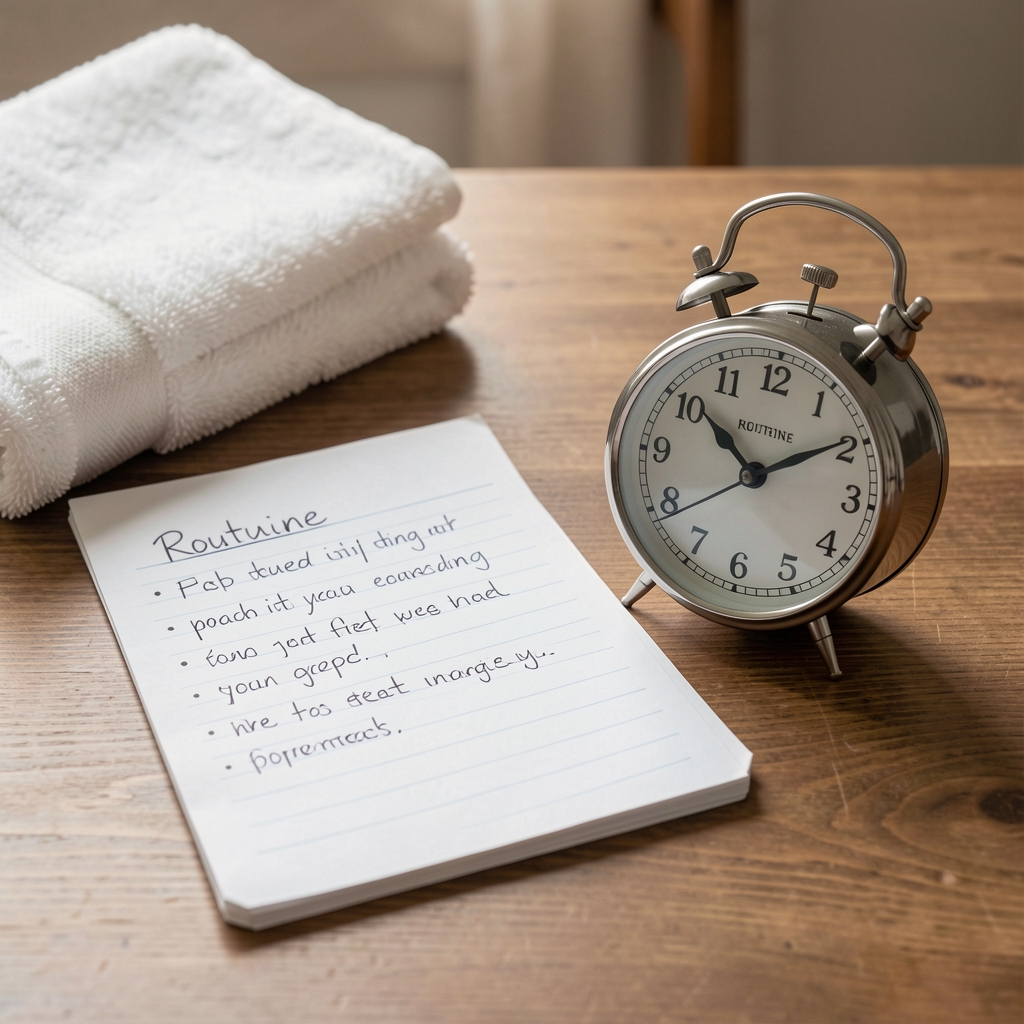
A routine is not a test
Schedules change. Weather, work, family commitments, and energy all matter. A flexible plan can be more useful than a perfect one. If the plan fails repeatedly, treat that pattern as information about the design.
- Keep equipment visible but safely stored.
- Use a timer only when it reduces uncertainty.
- Allow an abbreviated version for busy days.
- Decide in advance when to pause and reassess.
Consistency can include beginning again.
Routine planning table
| Planning detail | Helpful prompt | Example note |
|---|---|---|
| Place | Where can the activity happen safely? | Beside a stable chair with a clear path. |
| Time | Which transition is predictable? | After preparing tea, before opening messages. |
| Length | What is the smallest useful version? | A short sequence that can be completed without rushing. |
| Review | What should be changed next time? | Move the notes closer and choose a quieter moment. |
A weekly review
- Record what happened without harsh labels.
- Identify one helpful condition.
- Identify one obstacle that can be redesigned.
- Choose one small change for the coming week.
Reviewing the arrangement protects a routine from becoming a source of unnecessary pressure.
Common questions
Should a routine be identical every day?
No. Keep the intention stable while allowing the duration, time, or setting to respond to the day.
What if a person stops for several weeks?
Begin by understanding what changed. Travel, workload, weather, confidence, and household needs can all alter a plan.
How can a household help?
Ask what kind of support is welcome, protect a clear space, and avoid turning the routine into a public score.
Making the plan resilient
A routine becomes resilient when it has a clear return point. If a meeting interrupts the planned time, the person can know whether to move the activity, shorten it, or wait until the next suitable opportunity. This prevents one disrupted day from defining the whole arrangement.
Preparation should also account for the room. Place supports where they can be reached, keep pathways visible, and avoid adding equipment that creates another decision. A good plan is understandable to the person using it and to anyone invited to help.
- Name the usual version and the reduced version.
- Keep a written cue in the chosen location.
- Review the environment after a near miss or concern.
- Protect rest and ordinary household responsibilities.